That All May Be One

UCC’s 69 Birthday, Juneteenth, Father's Day
June 21st , 2026
Scripture: Galatians 3:23-29 & John 17:9-11, 17-23
Today is a joyous day as we celebrate who we are, where we’ve been, and look toward where the Spirit might be leading us next. Ancestral wisdom plays an essential part in who we are, why we are, and where we’re going. Or in other words, we have to know where we’ve been to know where we’re going! Therefore, today we remember the past 69 years of the United Church of Christ, as well as the centuries of faithful followers of Christ that led us here. See our story doesn’t begin 69 years ago, but rather in 1563 when the Puritans escaped the Church of England, taking refuge in Holland until one hundred of them boarded the Mayflower to establish a new life where they could worship as they pleased in the ‘New World.’ These settlers became the Congregationalist and Christian Churches, two of the four predecessor bodies of the UCC. When the Pilgrim’s pastor John Robinson (who, funnily enough, according to ancestory.com, is part of my family tree) sent his family and his flock to America, he told them not to hold too tightly to the traditions established by Reformers Luther and Calvin, for he was confident “the Lord has more truth and light yet to break forth out of God’s holy Word.” However, after about a decade, the colonies quickly turned rigid, becoming intolerant of new or different ideas.
But of course, not everyone went along with these changes. Roger Williams challenged this turn toward exclusion and was banished to Rhode Island, where, for a time, he established a colony that ensured jury trials, worked to end class discrimination and to extend universal suffrage and religious tolerance.. IN 1636!!! AND around the same time, John Eliot began ministering to the Indigenous population, employing Job Nesutan (a Native himself) as his co-pastor. Together, they translated the Bible into the local native language and taught the Natives to read.
Even more revolutionary is the story of Lemuel Haynes. He grew up in Connecticut, not as a slave, but as an indentured servant. In 1785, Haynes was ordained to serve his own church, making the Congregational Church the first ever to ordain a person of color. Haynes preached gospel messages that loudly opposed slavery, indentured servitude, and colonization. He advocated for the equal rights of persons of African descent brought to America… and remember, this was in 1785!! It would be another 78 years before the Emancipation Proclamation freed the slaves, and another 2 years before that liberating news would reach the last slaves in Texas on what we now celebrate as Juneteenth. This commitment to God’s liberating love for all people was not a ‘one-off’ either. This message was not reserved for one black man trying to free his people like Moses in Egypt. Many ministers in all four of our predecessor bodies were part of the abolitionist movement from the beginning; most of them white, standing in solidarity with their siblings in Christ, understanding that we are not free until all are free.

In 1789, when Christian Church minister James O’Kelley, denounced slavery from the pulpit of his church in Virginia, he attracted many blacks to the Christian Church of the South. This created multiple conferences fo black churches, where within the church, neither race nor gender were stumbling blocks to the gospel. Guys, this is still in 1789!!! For all four of our ancestral bodies, belief “in the transforming power of the gospel to right social evils, particularly inhumanity to other races and the injustice of slavery” was a foundational principle of what it meant to be a Christian, to follow the way of Jesus. But they didn’t just preach the gospel message; they embodied it. After the Civil War, these church bodies responded to the education and religious needs of both freed slaves and Native Americans by creating black colleges – six of which remain in
relationship with the UCC to this day.
After the Revolutionary War, European ties were broken and the churches of the colonies supported themselves completely for the first time. In the early 1800s, the Congregational Church and our other predecessor body, the German Reformed Church, established the first missionary societies in America. Surprisingly, the first missions were to the indigenous tribes, aiding them in resisting the government’s attempts to remove them from their lands. Another surprisingly amazing mission the board
commissioned was in sending Betsy Stockton, a female freed slave, and her crew of 13 to Hawaii in 1822. While there she taught school and homemaking, as well as nursed the sick.
The 1800s also brought about the first woman to be ordained in America! In 1853, Antoinette Brown was ordained by the Congregational Church of Butler New York. While Brown nurtured seven children at home, she wrote 9 books, advocated for the abolition of slavery and gender equality, and at the age of 95 in 1920, she cast her first vote one year before her death.
Our predecessors understood the need for Christians to be united, because how could the Church be agents of God’s healing throughout the world if it could not heal itself? In 1931, the Congregational Church united with the Christian Church. In 1934, the German Evangelical Church joined with the Reformed Churches. Four years later, talks began to unite these two bodies. However, it was a long road to unity. They spent 4 years discussing the union privately, six years after the public proposal drafting a ‘Basis for Union’ document, and then when the final draft finally came to a vote in 1950, the assembly was postponed for SEVEN years while some wavering churches battled in court. FINALLY, on June 25th, 1957 the United
Church of Christ, a combination of all this rich history and countless traditions, was born.
However, as history marches on, so do the challenges, which in turn challenges the Church to meet the moment with the gospel news; constantly begging the question, “who is Christ for us today?” The first two decades of the UCC’s life were pressed with difficult social and moral dilemmas, yet it never wavered on its mission to follow in the footsteps of Christ. Ministry in the 60s and 70s focused on desegregation and civil rights for all minorities, equal rights for women, withdrawal from Vietnam, just treatment of all people regardless of sexual preference, a more humane criminal justice system, and accessibility for all abilities. In fact, in 1972, the UCC ordained the first openly gay clergy, Rev. William R. Johnson, who founded what would become the Open and Affirming Coalition.
Again, the UCC floors me on its willingness to not only preach good news, but embody good news. In 1973, they flew 95 General Synod delegates to California to stand with the United Farm Workers and support Cesar Chavez in the fight for fair wages and safe working conditions. AND that General Synod raised $17 million dollars in order to help keep six Black American Missionary Association founded colleges open in the South (mentioned above).
There is so much more that involved in the rich history of those who came before us, but what is obvious is the dedication to preach the gospel and LIVE in the footsteps of Jesus who came to preach good news to the poor, liberate the oppressed, set the captives free, proclaim the year of the Lord’s favor, and show us the way to do the same.
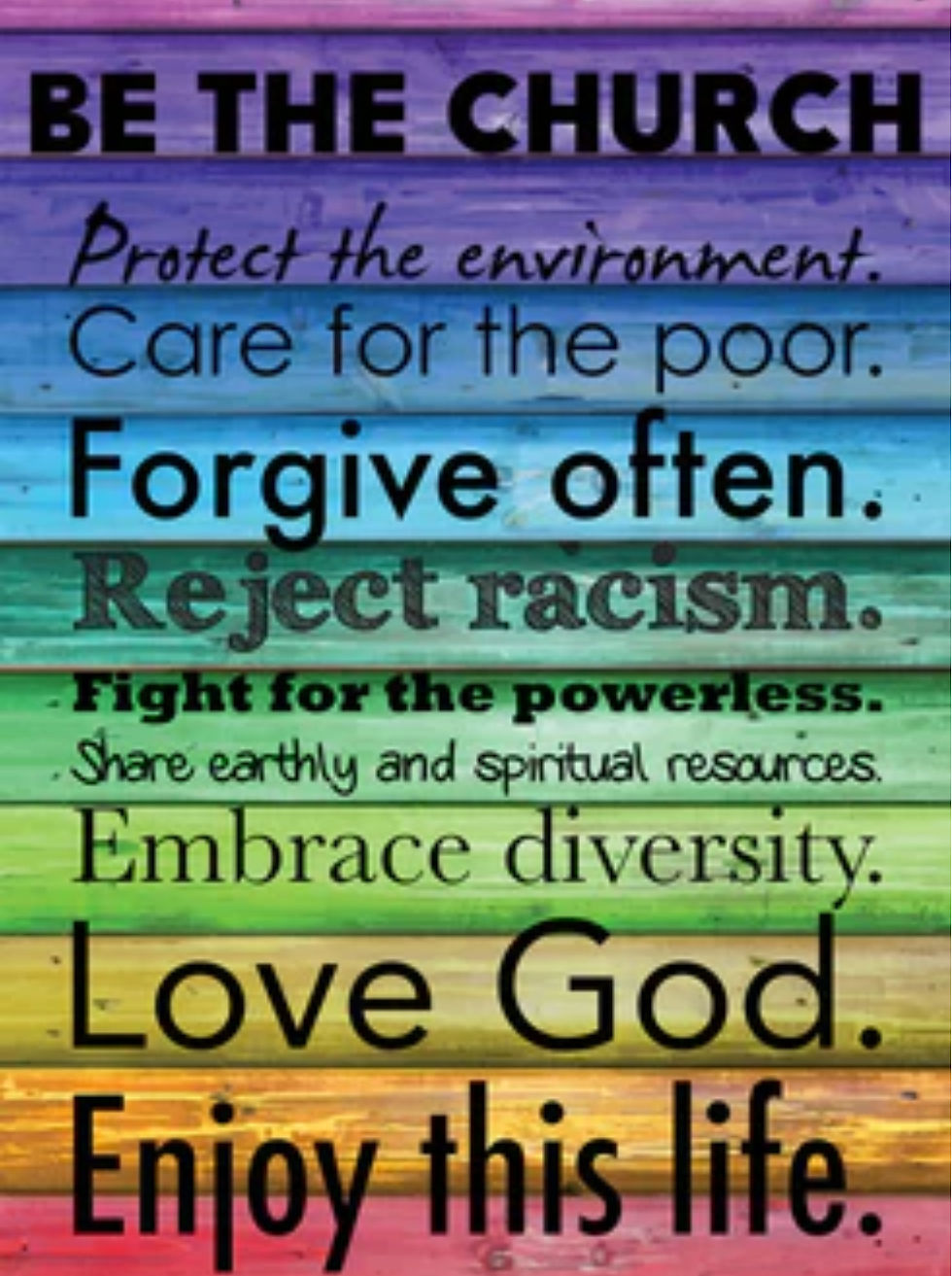
We have always been the voice of liberation, equality and life because we have always dedicated ourselves to being united in what is essential. What is essential is the reality that all people, the entirety of creation, belong to God and are loved by God. Love is our common thread, and it’s God’s love, not our own! We fall short in loving one another, we don’t always get it right, but God’s love never fails. By Christ’s liberating faith, we have been set free, we are all children of God; no longer Jew or Greek, slave or free, male or female, but all are ONE in Christ. Who we are, who we stand up for, and the values we live by today are NOT radical, or NEW or revolutionary. It’s who have always been. Who call has always called us to be. We have always ALWAYS been the people who believe that following Christ meant not only following with our hearts or minds, but also with our hands, feet, and voices.
The UCC declares its purpose is to love God and love our neighbor as ourselves; declares its vision to be a just world for all; and declares that its mission is to welcome all, love all, and seek justice for all. This is who we have always been. This is who we say we are. This is what will help us steer the ship, as we, like those before us, navigate the stormy seas of the present and future. God is, in fact, still speaking.
As we celebrate another year and anticipate a long life ahead, may we remember the words of Pastor John Robinson as he sent his flock to America, reminding them not to hold too tightly to what they had always known, for “the Lord has more truth and light yet to break forth out of God’s holy Word." Amen.
You can read about the UCC's history here:https://www.ucc.org/who-we-are/about/history/
Other noteworthy embodiments of the gospel that didn't make it in the sermon include, but are not limited to:
In 1777, the Liberty Bell and the bells of Christ Church in Philly were hauled to Allentown, PA where Pastor Abraham Blumer kept them safe under the floorboards of Zion Reformed Church
Congregationalist Churches were loud in condemning the War of 1812 as "unnecessary, unjust, and inexpedient"
Held full communion partnership with the Presbyterian Church from 1801-1837 (although this was cut off for a time, today we are once again in full communion partnership)
In 1887, Elvira Yockey, wife of a German Reformed pastor, founded and became the first president of the Women's Missionary Society of the General Synod. This paved the way for the Female Cent Society, which later became the Women's Society of the Congregational Christian Churches. From these groups came the deaconess movement, which produced women abolitionists, teachers, preachers, nurses, missionaries, and activists for women's rights (later merged into the Women's Guild)
Congregationalist Minister Washington Gladden is considered one of the 'fathers' of the Social Gospel and was one of the first influential clergy to advocate for unions, labor rights, and a cooperative economy.He also loudly opposed slavery and the unjust treatment of people of color. In 1905, he made national news headlines when he denounced Rockefeller's donation to the Congregationalist Church of $100,000 as tainted money. He wrote that, as a minister, he wanted to practice "a religion that laid hold upon life, and proposed first and foremost, to realize the Kingdom of God in this world."
The Niebuhr brothers were from our German Evangelical/Reformed predecessors - too much to say about them, their impact on Christian theology is massive!
1934 the General Synod of the Congregationalist Churches created a Council for Social Action which focused on service, international relations, citizenship, Japanese-Americans, rural life, and legislative, industrial & cultural relations
1948 part of the creation of the World Council of Churches
1969 Robert Moss was elected the new President of the UCC, advocating for the US's withdrawal from Vietnam, policies that would lessen rivalries in the Middle East, and he also served on the World Council of Church's committee standing against South African Apartheid
1973 General Synod of the UCC also voted to cover bail money for the North Carolina 'Wilmington 10,' plus provide legal and moral support throughout the seven years of their trial (look up the Wilimington 10!!)
1975 & 1977 General Synods of the UCC defended the basic human right of marriage to ALL and wrote a resolution "deploring the violation of civil rights of bisexual persons.' The other focuses were on handicap accessibility & opportunity, right to meaningful & remunerative work, world hunger, climate crisis, AND the social responsibility of multinational corporations
1985 General Synod of the UCC met in Ames IA and declared the UCC to be a 'Just Peace Church,' They also focused on the farm crisis, supported sanctuary for political refugees escaping Apartheid South Africa and from South America, as well as supported FULL divestments from ALL corporations doing business with South Africa!! This was also the first synod to urge ALL congregations to declare themselves Open & Affirming (ONA)
Comments